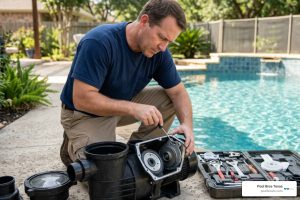
Why Is Your Pool Pump Making Loud or Unusual Noises?
A pool pump is the mechanical heart of your pool’s circulation system, designed to move thousands of gallons of water through filters, heaters, and sanitizers every single day. Under normal operating conditions, a healthy pump produces a consistent, steady low hum alongside the gentle sound of moving water. However, when mechanical friction, hydraulic restrictions, physical vibrations, or electrical component breakdowns occur, your pump will begin broadcasting distress signals in the form of loud, abnormal sounds.
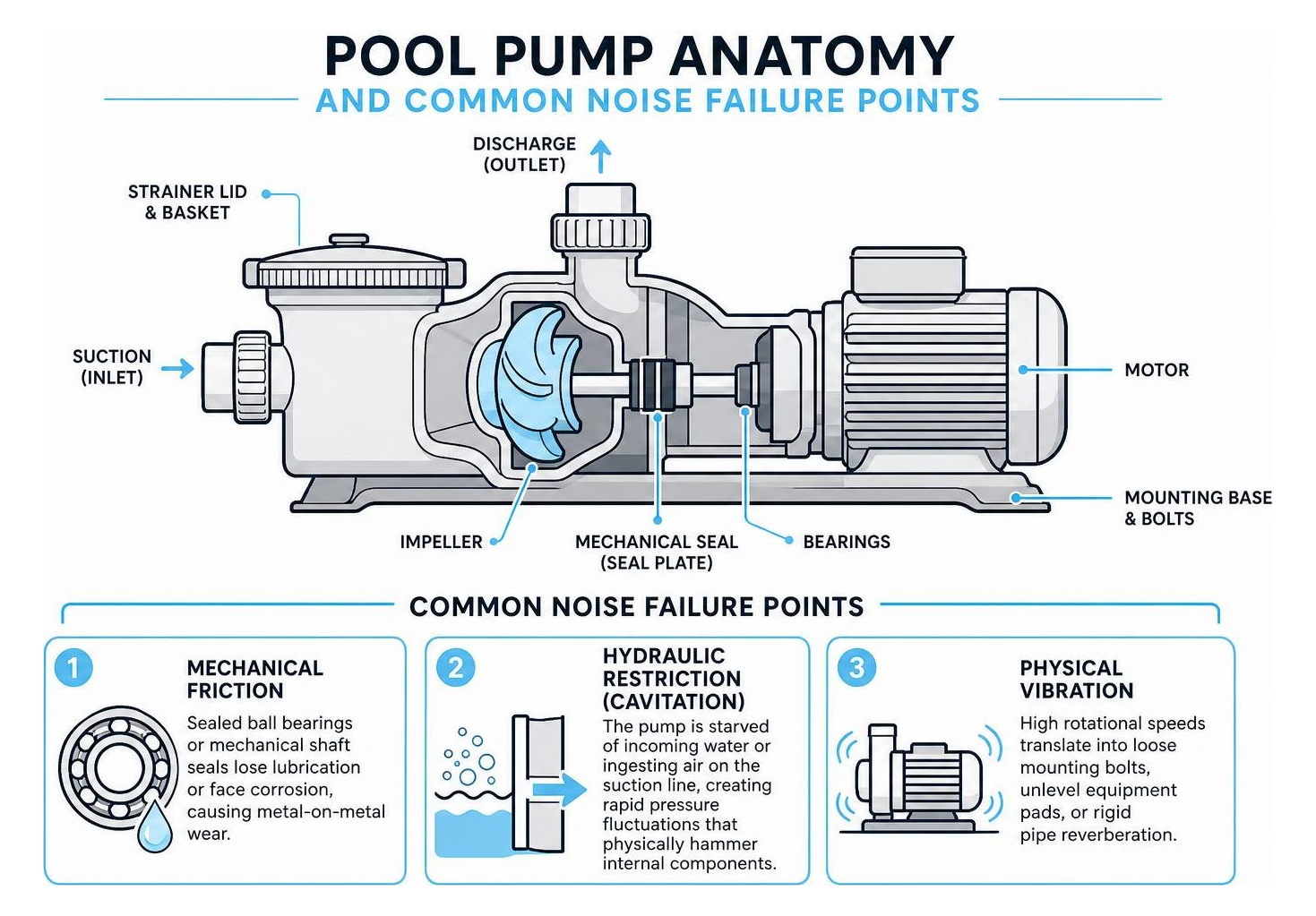
When a pump becomes excessively loud, it is usually struggling against one of four primary mechanical forces:
- Mechanical Friction: Moving internal parts, such as sealed ball bearings or mechanical shaft seals, lose their lubrication or face corrosion, causing metal-on-metal wear.
- Hydraulic Restriction (Cavitation): The pump is starved of incoming water or ingesting air on the suction line, creating rapid pressure fluctuations that physically hammer the internal components.
- Physical Vibration: High rotational speeds translate into loose mounting bolts, unlevel equipment pads, or rigid pipe reverberation.
- Electrical Resistance and Failure: Stator windings, capacitors, or variable-speed electronics struggle to deliver the torque required to spin the motor shaft.
Promptly diagnosing the source of this noise is critical. What starts as a minor $15 component issue or a quick debris clearout can rapidly cascade into total motor burnout, melted internal diffusers, or catastrophic equipment pad flooding if neglected.
Before inspecting any part of your pool pump, always practice strict safety: shut off the dedicated breaker at the main electrical service panel. Never perform physical or internal inspections on an energized motor.
What Are the 7 Most Common Causes of Pool Pump Noise?
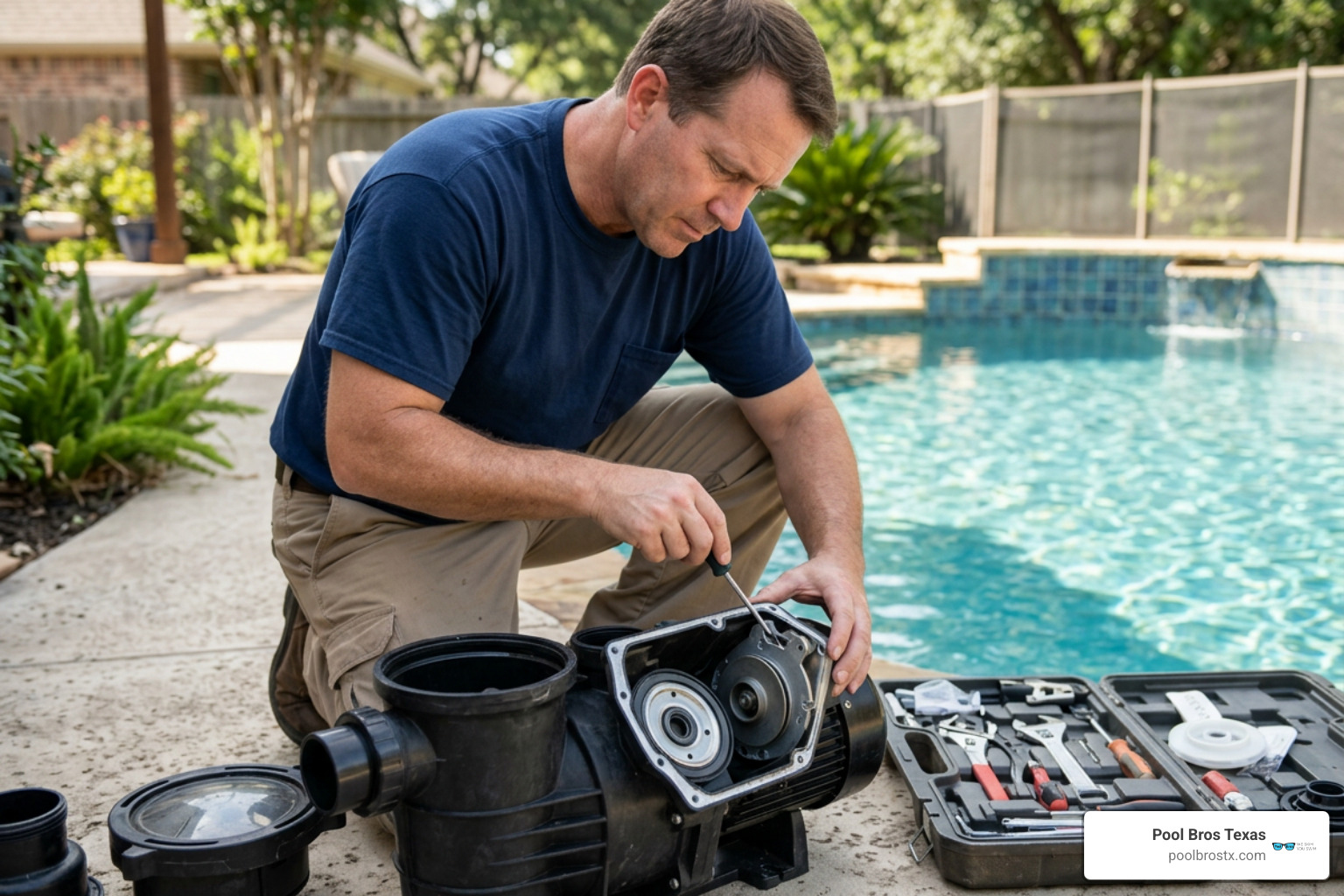
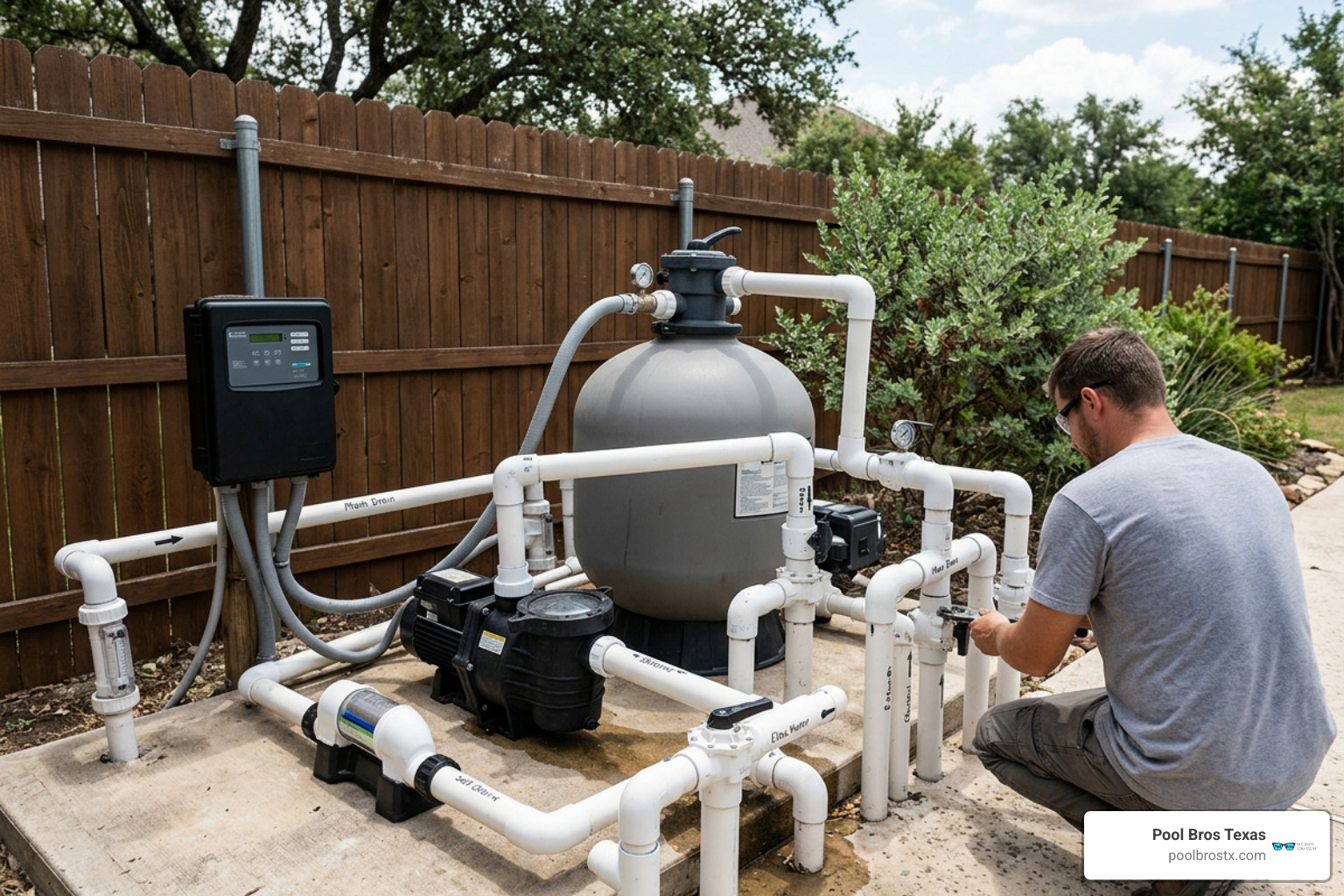
A pool pump consists of two major sections: the wet end (strainer basket, volute housing, diffuser, impeller, and mechanical shaft seal) and the dry motor end (electric motor, front and rear bearings, capacitor, cooling fan, and electronic drive). Noise can originate from either end or from the plumbing connecting them.
Understanding how these systems interact makes troubleshooting pump noise causes and fixes straightforward across single-speed, dual-speed, and modern variable-speed equipment. Let’s break down the 7 most common culprits.
1. Worn or Corroded Motor Bearings
Worn motor bearings are the single most frequent cause of excessive pool pump noise. When bearings fail, they produce an unmistakable high-pitched screeching, whining, growling, or metallic grinding sound from the rear motor housing. In many cases, the noise starts as a faint whine and progressively worsens over several weeks until it sounds like an airplane taking off or a screaming power tool in your backyard.
How Bearing Failure Happens
Inside your pump’s motor, the motor shaft is supported by two sealed, high-precision ball bearings (a front bearing near the wet end and a rear bearing near the cooling fan). These bearings contain steel balls packed in high-temperature grease.
Under normal residential operating conditions, sealed motor bearings have a typical service life of 8 to 12 years. However, when the pump’s mechanical shaft seal fails, pressurized chlorinated or saltwater slowly drips past the seal plate and migrates down the motor shaft directly into the front bearing. The corrosive pool water washes away the internal grease, causing bare metal-on-metal friction, severe rust, and rapid pitting of the bearing races.
Why You Shouldn’t Ignore Failing Bearings
Continuing to run a pump with screaming bearings generates extreme friction and thermal stress. The heat will melt the plastic components of the wet end, break down the motor winding insulation, and eventually cause the motor shaft to seize completely. Once the motor seizes, it draws locked-rotor amperage, tripping your breaker and potentially burning out the motor entirely.
2. Pump Cavitation and Suction-Side Air Leaks
If your pool pump sounds like it is chewing on gravel, rattling violently, or shaking like a blender full of marbles, the pump is likely suffering from cavitation.
The Physics of Cavitation
Cavitation occurs when a pump is starved of incoming water. When the impeller spins at high velocity (typically 3,450 RPM on single-speed units) without adequate water supply, it creates a severe low-pressure vacuum zone inside the pump housing. This extreme drop in pressure forces water to vaporize into microscopic air bubbles at ambient temperature. As these vapor bubbles travel from the low-pressure eye of the impeller to the high-pressure outer vanes, they implode violently.
These microscopic shockwaves generate immense hydraulic impact force, physically pitting and eroding the plastic impeller, degrading the diffuser, and creating a distinct gravelly knock.
Common Causes of Cavitation
- Low Pool Water Level: If pool water drops below the halfway point of the skimmer opening, a vortex (whirlpool) forms, pulling air directly into the suction line.
- Clogged Baskets: A skimmer basket or pump strainer basket packed with leaves, pine needles, or debris chokes off incoming water volume.
- Suction-Side Air Leaks: A dried, cracked, or misaligned pump lid O-ring, loose plumbing unions, or cracked intake valves allow air to be drawn into the pump under vacuum.
- Undersized Suction Plumbing: Plumbing that is too small for a high-horsepower pump restricts flow and creates chronic starvation.
How to Diagnose and Fix Suction Leaks
- Check the Pump Lid: Look through the clear pump lid while the motor runs. If you see a large pocket of churning air or heavy foaming instead of solid water, you have an air leak or restriction.
- Clean All Baskets: Empty both skimmer and pump strainer baskets thoroughly.
- The Water-Douse Test: Pour a steady stream of water from a garden hose over the pump lid O-ring, threaded intake fittings, and suction valves while the pump runs. If the air bubbles in the basket suddenly vanish and the pump quiets down, you have pinpointed the leaking joint. Replace the dried O-ring or reseal the fitting.
3. Debris Trapped in the Impeller
A chattering, clicking, ticking, or dull rhythmic knocking coming directly from the clear wet end of the pump often points to physical debris lodged inside the impeller.
How Debris Reaches the Impeller
The pump strainer basket acts as the primary barrier against physical debris entering the close-tolerance wet end. However, if the basket becomes cracked, floats out of its seated position, or is improperly installed after cleaning, small objects can bypass the basket. Small pebbles, acorns, twigs, palm tree fibers, and pine needles easily slip through the basket opening and become wedged inside the curved internal vanes of the spinning impeller.
When debris lodges in one or two vanes, it disrupts the hydrodynamic balance of the impeller. As the unbalanced impeller rotates, it wobbles on its brass insert, rubbing against the diffuser shroud and creating a rhythmic knocking or clanking noise while dramatically reducing circulation flow.
Step-by-Step Guide to Clearing a Clogged Impeller
- Kill Power: Shut off the pump’s circuit breaker at the electrical subpanel.
- Relieve Pressure: Open the manual air relief valve on top of your pool filter until the pressure gauge drops to zero.
- Open the Pump: Remove the pump lid and lift out the strainer basket.
- Reach into the Volute: Reach your fingers (or a curved wire hook / stiff piece of 12-gauge electrical wire) through the intake hole at the back of the pump pot into the center eye of the impeller.
- Clear Obstructions: Rotate the impeller slightly by hand while feeling inside each internal vane. Hook out any compacted pine needles, seeds, or small stones.
- Inspect for Damage: Check the plastic face of the impeller for cracks, melted edges, or severe scoring. If the shroud is cracked or warped, replace the impeller assembly.
- Reassemble and Prime: Replace the clean basket, lubricate the lid O-ring with silicone lubricant, secure the lid, and restore power.
4. Failed Start or Run Capacitor
When you switch on your pool pump and hear a loud, continuous electrical buzzing or humming noise, but the motor refuses to spin and trips the circuit breaker after 5 to 10 seconds, a blown start capacitor is the primary suspect.
The Role of the Capacitor
Single-phase pool pump motors rely on capacitors (cylindrical metal or plastic electrical storage components housed in teardrop-shaped covers on the top or rear of the motor). The start capacitor delivers an immediate out-of-phase burst of electrical torque (a rotational “kick”) to overcome the resting inertia of the rotor and start the shaft spinning. Once the motor reaches roughly 75% of its operating speed, an internal centrifugal switch disengages the start capacitor, handing operation over to the run windings.
When the capacitor degrades or blows, the motor receives single-phase running current without the rotational phase shift needed to start moving. The electricity simply dead-ends in the windings, creating a loud electrical hum and immense heat until the thermal overload protector trips the circuit.
Diagnostic Indicators of a Bad Capacitor
- Visual Deformation: Remove the metal capacitor cover (after cutting breaker power). A failed capacitor will often exhibit a bulging top rubber plug, a cracked casing, or visible oily fluid leaking from its terminals.
- Burnt Odor: A distinct acrid, electrical burning smell lingering inside the capacitor housing.
- Multimeter Testing: Using a digital multimeter with a microfarad ($\mu\text{F}$) capacitance setting, discharge the capacitor safely with an insulated screwdriver, disconnect the leads, and measure the reading against the rating printed on the label.
Start capacitors typically cost between $15 and $40 and represent one of the most cost-effective DIY fixes you can perform before assuming the motor itself is seized.
5. Leaking Mechanical Shaft Seal
A high-pitched chirping, squeaking, or intermittent squealing noise paired with visible water dripping or calcification beneath the pump indicates a compromised mechanical shaft seal.
How the Shaft Seal Operates
The mechanical shaft seal sits directly behind the impeller on the motor shaft, forming the watertight boundary between the flooded wet end and the dry electric motor. It consists of two spring-loaded, precision-lapped faces: one stationary ceramic ring seated in a rubber cup within the seal plate, and one rotating carbon-graphite ring mounted on a stainless-steel spring assembly.
Under normal conditions, a micro-thin film of water lubricates the ceramic-carbon interface. Over time (typically 5 to 8 years), chemical exposure, water balance fluctuations, or brief dry-running periods cause the seal faces to score, crack, or overheat.
The Chain Reaction of Seal Failure
When the seal faces lose their mirror-smooth mating surface, they begin to chirp and vibrate. More critically, pressurized pool water starts spraying past the seal plate flange. If ignored, this chlorinated water runs directly along the motor shaft and past the front bearing slinger, washing out the front motor bearing within 2 to 4 weeks. Whenever you replace motor bearings or rebuild a pump wet end, always install a brand-new mechanical shaft seal assembly.
6. Equipment Pad Vibration and Loose Mounting Hardware
Not all pool pump noise originates from internal mechanical failure. A deep, low-frequency drumming, rattling, or rumbling sound that reverberates through your backyard patio or travels through the exterior walls of your house is often caused by equipment pad vibration.
Sources of Amplified Vibration
- Loose Motor Mounting Hardware: The bolts securing the pump foot to the equipment pad or the motor to the wet end flange vibrate loose over thousands of operating hours.
- Unlevel or Cracked Equipment Pads: Pre-cast plastic or settling concrete pads create hollow voids underneath the pump base, acting as an acoustic sounding board that amplifies normal motor rotation.
- Rigid PVC Plumbing Transmission: Long, unsupported runs of schedule 40 PVC pipe bolted directly to brick walls act as structural conductors, transmitting hydraulic pulsing and motor vibrations straight into the home’s framing.
How to Eliminate Pad Vibration
- Torque Mounting Bolts: Check all mounting hardware between the pump base and the motor flange, tightening any loose nuts to manufacturer specifications.
- Install Vibration-Isolation Pads: Slide a heavy-duty composite rubber-and-cork anti-vibration pad beneath the pump mounting foot to decouple the motor from the concrete slab.
- Secure Plumbing Lines: Install rubber-lined pipe clamps on long suction and return PVC runs to eliminate hydraulic pipe shudder.
7. Variable-Speed Cooling Fan or Drive Obstructions
Modern variable-speed (VS) pool pumps are engineered to run whisper-quiet, especially at low filtration speeds. However, when an unfamiliar clicking, rapid ticking, high-pitched whirring, or electronic whine develops on a VS unit, the issue is typically linked to the cooling fan cowl or electronic drive assembly.
Cooling Fan Obstructions
Because totally enclosed fan-cooled (TEFC) motors rely on an external fan attached to the rear motor shaft, leaves, pine needles, or small twigs can easily be sucked through the rear protective grille. The spinning fan blades will strike the foreign object with every rotation, creating a loud clicking or clattering sound that scales up and down with motor RPM.
Drive Assembly and Inverter Whine
Variable-speed pumps incorporate an integrated drive module on top of the motor that converts incoming AC power to DC to modulate motor speed. During hot summer weather, when ambient temperatures surge, the electronic inverter works under significant thermal load.
A high-frequency electrical whine can occur if the cooling fins on the drive heat sink become clogged with dirt, insects, or dryer lint, restricting airflow. Regularly brush off the drive heat sink fins and maintain at least 12 to 18 inches of clear ventilation space around the rear motor cowl.
How Do You Diagnose a Pool Pump Based on the Sound It Makes?
Pinpointing the origin of an abnormal noise allows you to take corrective action before minor wear turns into catastrophic equipment failure. Use this pool pump sound diagnostic guide and our quick-reference troubleshooting matrix below to match the sound you hear with its likely root cause:
| Sound Type |
Primary Location |
Likely Root Cause |
Urgency Level |
Estimated Repair Cost |
| High-Pitched Screeching / Grinding |
Rear motor housing |
Worn or corroded motor bearings |
High (Risk of motor seizure) |
$80–$150 (bearing repack) or $200–$600 (motor replacement) |
| Gravel Knocking / Violent Popping |
Wet end / Impeller |
Cavitation (water starvation or air ingestion) |
High (Impeller erosion) |
$0 (clear basket / add water) to $50–$150 (re-plumb suction leak) |
| Loud Humming / Buzzing (No Spin) |
Motor housing |
Blown start capacitor or seized rotor |
Immediate (Trips breaker) |
$15–$40 (DIY capacitor) or $200–$600 (new motor) |
| Chattering / Ticking / Clanking |
Strainer pot / Volute |
Debris trapped inside impeller vanes |
Moderate (Flow restriction) |
$0 (DIY clearout) or $30–$80 (replacement impeller) |
| High-Pitched Chirping + Dripping |
Seal plate / Flange |
Worn mechanical shaft seal |
Moderate (Will ruin bearings) |
$20–$50 (parts) or $150–$250 (pro seal service) |
| Deep Drumming / Low Rumble |
Equipment pad / Base |
Loose mounting bolts or pad vibration |
Low (Acoustic annoyance) |
$15–$40 (rubber anti-vibration isolation pad) |
| Rapid Ticking / High Electronic Whine |
Rear fan / Top drive |
Fan cowl debris or drive thermal strain |
Low to Moderate |
$0 (clear fan grille) or professional drive diagnostics |
| Single Soft “Click” on Startup |
Internal motor switch |
Normal centrifugal switch operation |
Normal (No action needed) |
$0 (Standard mechanical function) |
Understanding Startup Clicks vs. Structural Rattles
A single, distinct click heard immediately as a single-speed pump spins up or slows to a stop is completely normal. This is the mechanical centrifugal switch disengaging the start capacitor circuit once the motor reaches running speed. However, repetitive clicking, continuous rattling, or mechanical squealing requires prompt intervention.
Is It Cheaper to Repair or Replace a Noisy Pool Pump?
When facing a noisy pump, every pool owner must weigh the cost of individual component repairs against the long-term reliability and efficiency of full equipment replacement.
The “50% Rule” and Equipment Age
In the pool industry, we utilize the 50% Rule: if the estimated cost of repairing the pump exceeds 50% of the cost of a brand-new unit—and the current pump is more than halfway through its expected lifespan—replacement is almost always the more economical choice.
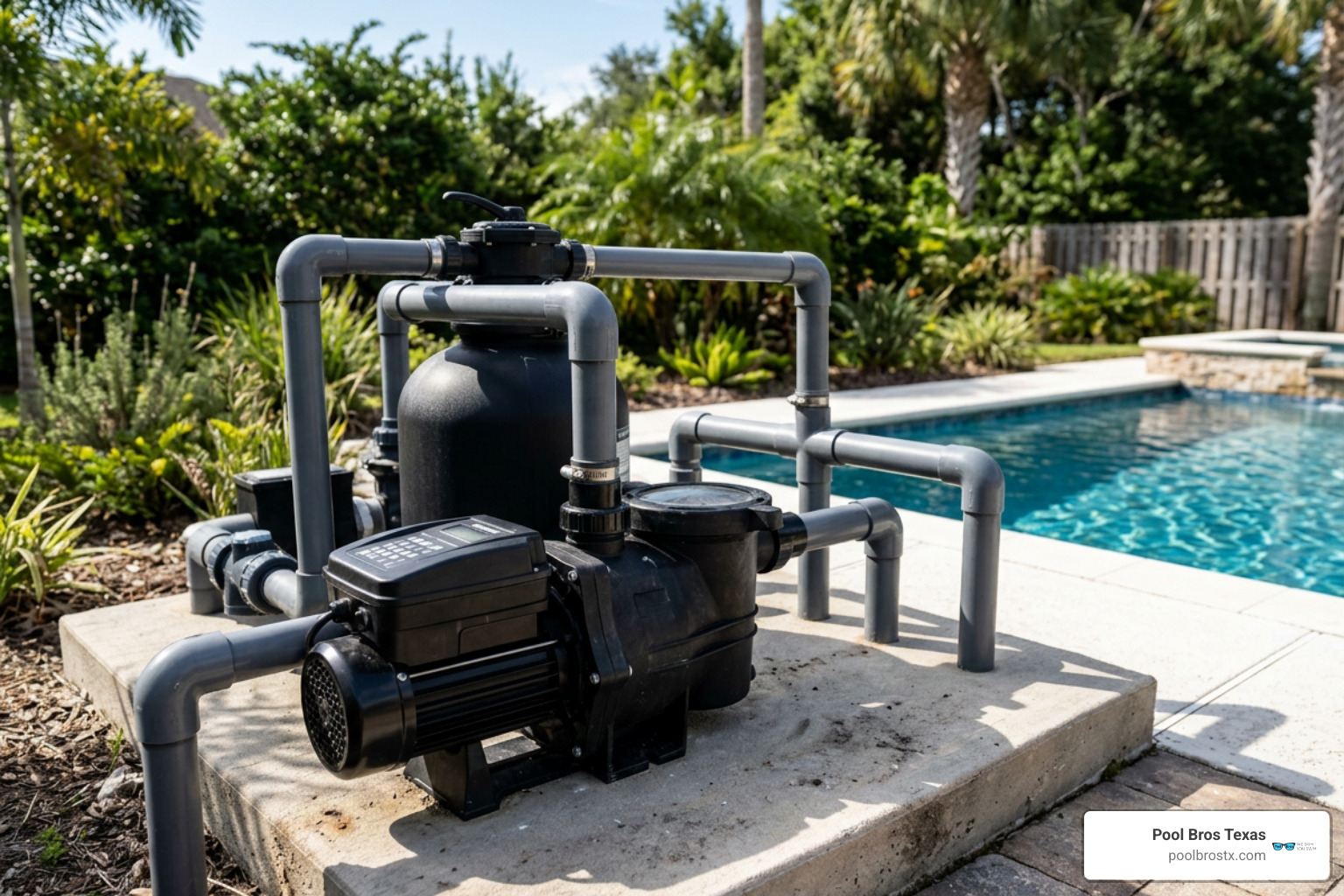
Consider these general benchmarks:
- Pumps Under 5 Years Old: If the wet end housing is in good structural condition and only a single component fails (such as a $15–$40 capacitor, a $30 shaft seal, or an $80–$150 motor bearing repack at a local motor shop), repairing the existing unit makes complete financial sense.
- Pumps Between 5 and 8 Years Old: If the motor requires a complete replacement ($200 to $600 for the motor alone), evaluate the condition of the wet end plastic. If the housing, lid threads, and seal plate are brittle or warped from sun exposure, spending money on a new motor attached to a degraded wet end often leads to secondary leaks.
- Pumps Over 8 to 10 Years Old: Legacy single-speed pumps have an average service life of 8 to 12 years. If a pump of this vintage develops major motor bearing failure or winding burnout, replacing the entire system is significantly smarter than sinking money into aging mechanics.
The Massive Efficiency Advantage of Variable-Speed Upgrades
Upgrading an outdated, noisy single-speed pump to a modern variable-speed pump transforms both your backyard noise levels and your monthly utility bill.
Legacy single-speed pumps operate exclusively at 3,450 RPM, consuming massive amounts of electricity and operating at high acoustic decibels. In contrast, variable-speed pumps utilize ultra-efficient permanent magnet motors (similar to those used in electric vehicles) that can run at low speeds (such as 1,500 RPM) for routine filtration.
- Energy Savings: A variable-speed pump running at 1,500 RPM consumes roughly 85% less electricity than a standard single-speed pump running at 3,450 RPM.
- Acoustic Performance: At low speeds, variable-speed pumps operate between 40 and 50 decibels—quiet enough to hold a normal conversation right next to the equipment pad.
- Extended Lifespan: Because variable-speed motors run cooler and suffer far less mechanical and thermal vibration, they typically last 10 to 15+ years under proper residential maintenance.
How Can You Prevent Pool Pump Noise and Equipment Failure?
Preventive maintenance is the most effective way to protect your pool equipment from premature wear, unwanted noise, and costly mid-season breakdowns. Incorporate these proactive practices into your monthly pool care routine:
- Maintain Proper Water Level: Keep your pool’s water level consistently at the midpoint of the skimmer opening (roughly 2 to 3 inches above the bottom of the skimmer frame). This prevents vortexing and keeps air out of the suction lines.
- Inspect and Empty Baskets Weekly: Regularly clean both skimmer and pump strainer baskets. Always inspect the pump basket for hairline cracks or warping that could let fine debris reach the impeller.
- Lubricate the Pump Lid O-Ring: Every 2 to 3 months, clean the pump lid O-ring and apply a generous coat of silicone-based pool lubricant (never use petroleum jelly, which degrades rubber). Ensure the lid seating groove is free of grit.
- Monitor Filter Pressure: Clean or backwash your pool filter whenever the pressure gauge rises 8 to 10 PSI over its clean starting baseline. Excessive filter backpressure places unnecessary hydraulic strain on pump bearings and seals.
- Never Run the Pump Dry: Ensure the pump pot is fully flooded with water before starting the motor after cleaning or maintenance. Running a pump dry for even 60 seconds can scorch the mechanical shaft seal faces.
- Maintain Balanced Water Chemistry: Corrosive, low-pH water ($<7.2$) or high salt levels can degrade internal rubber O-rings, corrode motor shafts, and pit mechanical seals.
- Schedule Annual Equipment Checkups: Book seasonal tune-ups and professional pool equipment inspections to test motor amp draw, inspect shaft seals, and detect early bearing wear before catastrophic motor burnout leaves you with cloudy, stagnant water.
Frequently Asked Questions About Noisy Pool Pumps
Is it safe to run a pool pump that is making a grinding noise?
No, it is not safe to run a pool pump continuously when it is producing a metallic grinding or screeching noise. Grinding indicates that the internal ball bearings have lost their lubrication and are wearing metal against metal. This friction creates severe heat that will quickly melt the shaft seal, warp the wet end plastic housing, and destroy the motor windings. If you must run the pump while waiting for parts or a service technician, limit operation to the bare minimum (1 to 2 hours per day) strictly to circulate essential sanitizer, and monitor the equipment closely.
How long do pool pump motors typically last before getting loud?
A well-maintained pool pump motor typically lasts 8 to 12 years in standard residential service. Modern variable-speed pumps frequently achieve 10 to 15+ years of reliable life. However, motors operating in extremely hot, humid climates or setups with unbalanced water chemistry and recurring shaft seal leaks can develop bearing noise in as little as 3 to 5 years.
Why is my brand-new pool pump making a loud humming sound?
If a newly installed pool pump hums loudly or cavitates immediately, the issue is almost always installation-related rather than a defective pump. Common causes include:
- Suction Line Air Leaks or Blockages: The pump was not properly primed with water, or an intake union is pulling air.
- Incorrect Input Voltage: Dual-voltage motors (115V/230V) factory-set for 230V will hum and fail to start if connected to a 115V electrical supply.
- Restricted/Undersized Plumbing: Installing a high-flow pump on narrow 1.5-inch suction plumbing can choke the pump and cause severe hydraulic cavitation.
- Unlevel Mounting Base: The pump was bolted down tightly to an uneven pad, warping the housing and causing the impeller to rub against the internal diffuser.
How Can Pool Bros Texas Help Restore Quiet Operation to Your Pool?
A noisy pool pump is more than just a backyard nuisance—it is an early warning system indicating that mechanical or hydraulic failure is underway. Addressing pump noise immediately protects your investment, keeps your pool water crystal clear, and saves you money on major equipment replacements.
At Pool Bros Texas, we provide an all-in-one, end-to-end solution for residential and commercial pool owners throughout the greater Houston, TX area. Whether you need a rapid seal rebuild, a motor bearing replacement, emergency pump troubleshooting, or a complete upgrade to an ultra-quiet, energy-efficient variable-speed system, our team delivers contract-free premium care and rapid repair priority.
If your pool pump is grinding, humming, or vibrating, don’t wait for the motor to seize. Visit Pool Bros Texas today to schedule an expert equipment evaluation and let our experienced team restore quiet, worry-free performance to your backyard oasis.